Sheffield Alcohol and Network Dynamics
SAND longitudinal data infrastructure
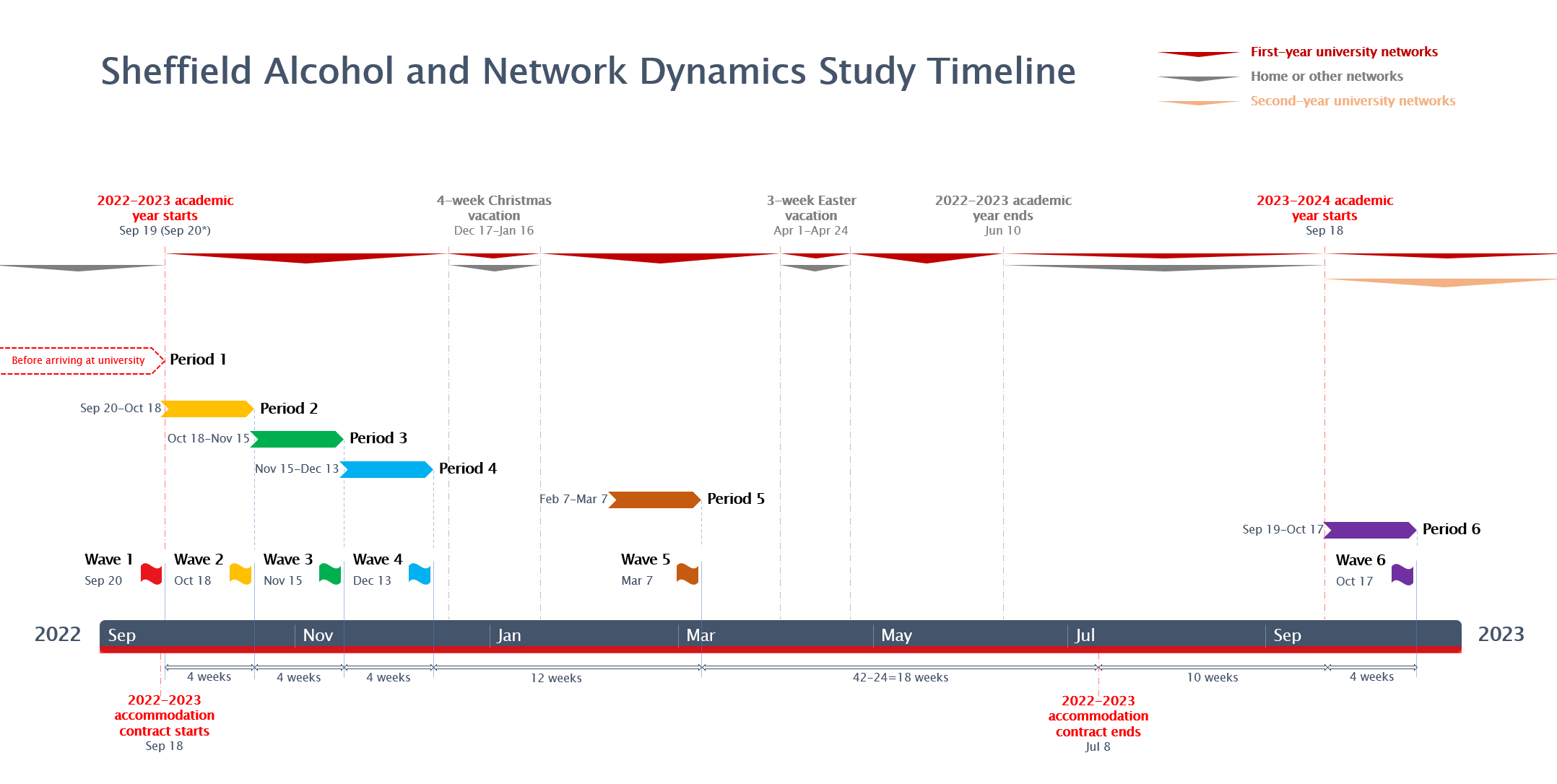
A six-wave residence-hall study of alcohol use, perceived norms, and social-network change among 255 first-year students. This page covers the project scope and what I built. The full technical reference lives at sand.shangshanggu.com.
Build scope: study design, participant operations, REDCap/MySQL setup, de-identified linkage, QA checks, chapter datasets, proxy data, and public-release notes.
This page excludes: raw records, real identifiers, contact fields, free text, and real network ties.
Build Scope
The study required the machinery around the analysis: recruitment, repeated survey delivery, identity separation, network-array preparation, and a reproducible pipeline that can run without exposing restricted data.
Participant operations
Recruited and onboarded 255 of 375 invited residents, then managed reminders, retention, incentives, and participant-facing support across six waves.
Survey and database system
Maintained REDCap/MySQL infrastructure with study-specific survey links, email validation, anonymous enquiries, referral-code logic, and automated incentive workflows.
Confidential linkage
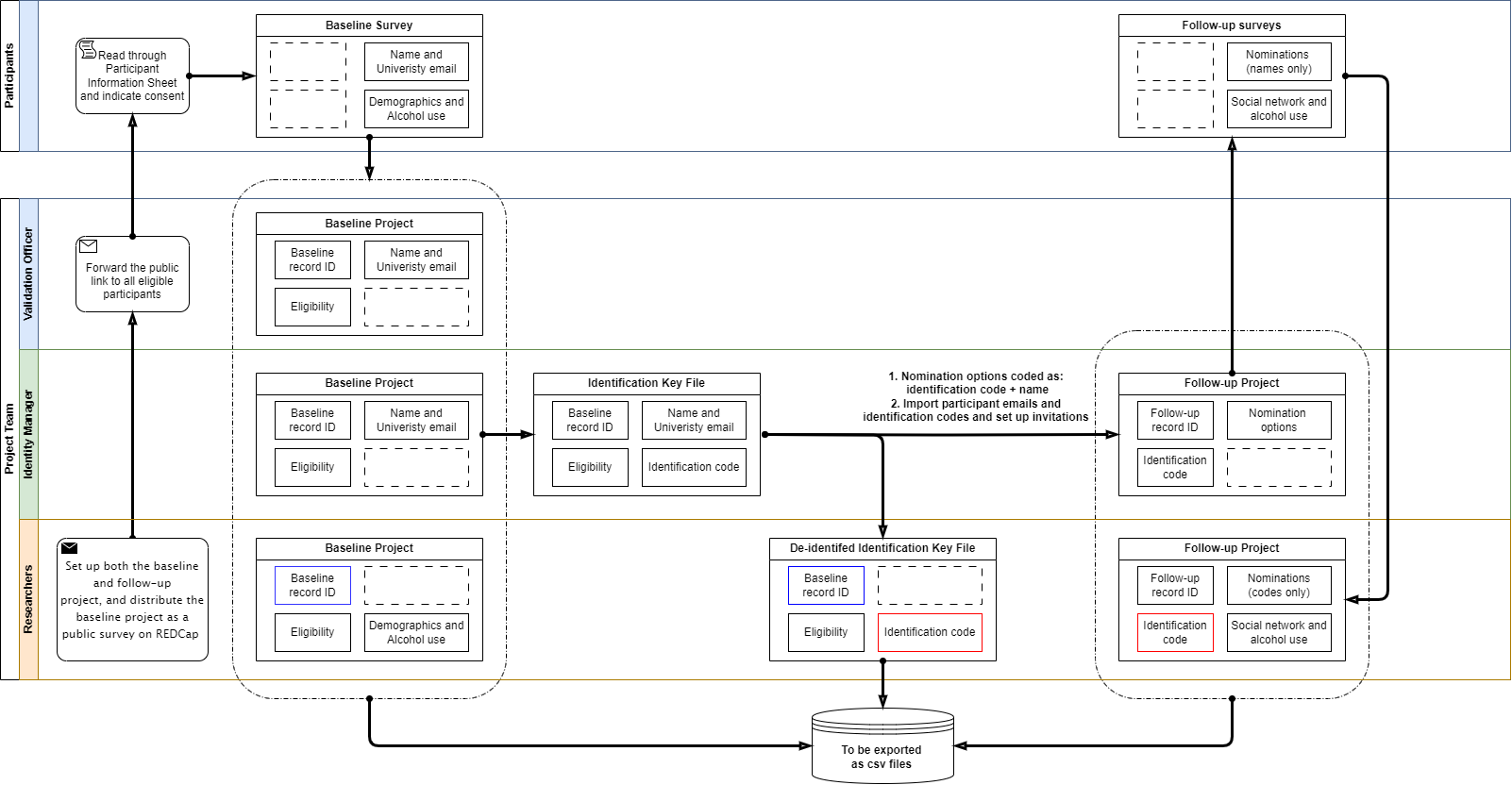
Separated contact details from behavioural responses and converted named important-peer nominations into pseudonymous IDs for analysis.
Reproducible analysis
Built R/Make pipelines from raw exports to QA reports, longitudinal datasets, network arrays, model inputs, tables, figures, and provenance logs.
Network modelling prep
Prepared aligned behaviour arrays and directed adjacency matrices for network autocorrelation models and stochastic actor-oriented models.
Public-release tooling
Added proxy-data mode, generated dictionaries, privacy checks, checksums, validation notes, and this public study-book preview.
Design Problem
Sociocentric network data create an awkward requirement: students need to see names when they nominate peers, but the analysis files should not expose names, emails, or contact fields. SAND handled that with separate REDCap projects, an identity-manager key, and de-identified exports for the research workflow.
Roster, blinded
Participants selected names in the survey. Research exports carried coded identifiers, so the analysis could rebuild nominations without publishing names.
Six waves, one linkage
Baseline and follow-up data used different REDCap records. The linkage file connected those records while keeping names and emails outside the analysis repo.
Restricted topology
Real edge lists, adjacency matrices, and anonymized network plots stay out of the public page. The site shows structure, schema, and proxy-mode documentation instead.
Fieldwork Record
Operational numbers that give context for the infrastructure: recruitment, retention, and response coverage.
Explore Further
Study design, wave maps, data dictionaries, key findings, the full REDCap infrastructure, the R/Make pipeline, and release verification are documented in the technical reference. The analysis code is open-source.
Technical reference
Full documentation: study design, REDCap/MySQL infrastructure, identity separation, data dictionaries, the analysis pipeline, key findings, and release verification.
sand.shangshanggu.comSource code
Reproduction pipeline for Chapters 4–7. Proxy mode runs without restricted data. Chapters 4–6 verified; CI-tested.
MIT · github.com/shangshanggu/sand-publicNetwork visualisations
Interactive views of the important-peer network at waves 2, 4, 5, and 6 with anonymised labels.
shangshanggu.com/sand/networksData access: public material includes design notes, schema summaries, and synthetic proxy data. Participant records, contact fields, linkage keys, and real network files stay restricted.